Settings
 Fast Delivery
 Payment Types


 Marketplace Product

DC/DC Converters Bridge 48 V Input with 12 V Industrial Loads to Boost Efficiency, Power Density
Contributed By DigiKey's North American Editors
2026-08-04
DC/DC voltage converters are found wherever input voltage, such as that supplied by a battery or external power supply, differs from the voltage needed by system components, often referred to as points of load (PoLs). Consumer electronics like mobile phones use DC/DC converters to provide a consistent voltage to internal components as the battery discharges and the supply voltage drops.
DC/DC voltage converters in industrial applications operate at higher voltages than those in mobile phones, but their function is the same. They adjust the supply voltage so it can be used in data center applications such as fans, network interface cards, hard drives, and AI servers. DC/DC converters are also used to provide the correct voltage for LED displays, industrial automation and robotics, and automatic test equipment.
These applications, which are often designed for 12 V power supplies, offer the proven reliability their industries demand, but they require DC/DC converters when connected to industrial power distribution networks (PDNs) that operate at a different voltage. This article will review why engineers choose DC/DC converters, how they work, and the features and implementation options engineers should consider when selecting a DC/DC converter for a given application.
The 48 V advantage
As electronic systems continue to evolve toward greater power requirements, designers of data centers, advanced manufacturing and industrial applications, and rugged military and commercial-off-the-shelf (COTS) applications are increasingly choosing 48 V PDNs to distribute power to system components. These PDNs are electrically efficient while keeping voltage safely low.
Each powered device or PoL has its own wattage requirement. Because electrical power is defined as the product of voltage and current, increasing the supply voltage reduces the current needed. Required currents on a 48 V PDN are a quarter of what they would be on a 12 V PDN operating at the same power levels. Smaller currents allow for smaller-diameter conductors and connectors and greater conductor density while reducing wiring losses, electromagnetic interference, and heat generation.
A potential of 48 V is considered within safety extra-low voltage (SELV) levels by industry standards such as IEC 62368-1. That means the system's voltage levels remain safe for human contact at all times, even in a single-fault state. Systems that meet SELV criteria do not need additional safeguards to protect personnel from dangerous voltages.
These advantages are driving the widespread adoption of 48 V PDNs, but many PoL devices are designed to operate from a 12 V supply. Instead of redesigning these components, which have already proven their reliability and cost-effectiveness at 12 V, design engineers add a DC/DC conversion stage to bridge the 48 V PDN to a 12 V bus or PoL.
DC/DC converter design
DC/DC converter designs include linear regulators and switching regulators, also known as switch-mode DC/DC converters. Linear regulators use power transistors that act like variable resistors to achieve the target output voltage, dissipating excess voltage as heat. Though they are simple in design, their low efficiency makes them impractical in applications with large voltage drops.
A switch-mode DC/DC converter temporarily stores energy in the magnetic field of an inductor while transferring power from the input to the output. A solid-state switch, such as a metal oxide semiconductor field effect transistor (MOSFET), rapidly switches on and off to control the amount of energy stored in the inductor and the amount transferred to the output. A controller continuously compares the converter’s output voltage with a setpoint and adjusts the timing of the MOSFET switch to achieve the desired output voltage.
Despite the rapid switching of the MOSFET, it still spends the majority of its time in fully-on and fully-off states, in which no energy is lost. The small amount of energy lost during the act of switching translates to an efficiency greater than 95% in many applications. In contrast, a linear regulator converting a 48 V supply to a 12 V supply is only 25% efficient.
The actual configuration of these components depends on whether the converter is stepping the voltage down (buck), stepping it up (boost), or expected to perform both functions (buck-boost). In any configuration, the converter’s controller manages switching to account for variations in input voltage or load, and an output capacitor smooths out voltage ripples for a stable, regulated DC output.
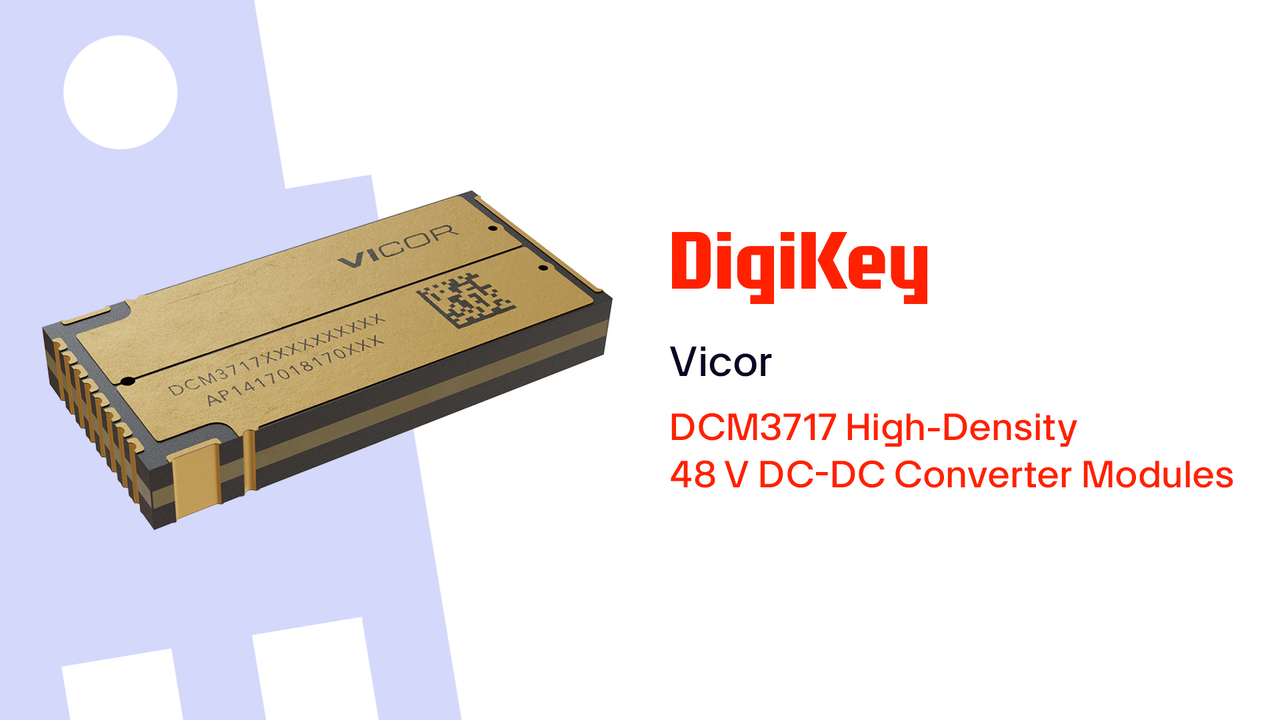
An example of this kind of switch-mode converter is Vicor Corporation’s DCM3717 series. These DC/DC converters (Figure 1) combine a buck-boost configuration with additional proprietary architectures to efficiently bridge 48 V PDNs to 12 V loads.
 Figure 1: Vicor Corporation’s DCM3717 non-isolated, regulated, DC/DC buck-boost converters bridge 48 V PDNs to 12 V loads with up to 96.5% efficiency. (Image source: Vicor Corporation)
DCM3717 non-isolated converters have a semi-regulated input range of 40 V to 60 V. True galvanic isolation is not required in most PDN applications because isolation is provided where power enters the system, and because input and output commonly use the same chassis ground. The DCM3717 converters have an adjustable regulated output between 10 V and 12.5 V, handle currents up to 82 A, and have an output power of 750 W or 1 kW.
DCM3717 converters achieve efficiencies of up to 96.5% using Zero Voltage Switching (ZVS) architecture. Circuits with ZVS are configured so that MOSFETs turn on when the voltage across them is close to zero. This technique minimizes switching losses, enabling higher-frequency operation with smaller magnetic components that support higher power density.
Following the buck-boost conversion stage and output capacitor, DCM3717 converters efficiently transfer power to the output using proprietary Sine Amplitude Converter (SAC) circuitry. These resonant circuits generate sinusoidal current and voltage waveforms, further reducing conduction and switching losses.
Implementing efficiency
In addition to their efficiency-boosting architecture, DCM3717 converters have a form factor that supports high power densities. Their surface mount, converter-housed-in-package (SM-ChiP) configuration is 36.70 mm long by 17.30 mm wide by 5.20 mm tall (Figure 2). They take up roughly half the printed circuit board (PCB) area of conventional switching converters in eighth-brick packages. By choosing more compact DCM3717 converters, engineers can shorten power paths, reduce parasitic resistance and inductance, and improve airflow, all of which support greater system power densities.
 Figure 2: DCM3717 converters support high power densities with their compact form factor, enabling designers to shorten power paths and improve airflow. (Image source: Vicor Corporation)
The use of surface-mount technology (SMT) in DCM3717 converters contributes to the compact package, especially compared to the through-hole pins or baseplates needed to connect converter bricks to a PCB. SMT also improves manufacturing efficiency by leveraging repeatable, automated pick-and-place assembly processes and minimizing hands-on assembly.
Engineers can also build scalability into their systems with the DCM3717 converters’ parallel capability. Their current-sharing circuitry can support up to four units operating in parallel, which gives engineers more flexibility in PCB layout and thermal management. For instance, a 48 V PDN could house four parallel DCM3717 units, each providing 1 kW of power to a 12 V bus that feeds multiple 12 V PoLs or additional DC/DC voltage converters.
DCM3717 converters are also equipped with Power Management Bus (PMBus)-compatible telemetry. This system allows a controller to monitor voltages, currents, temperatures, and faults during converter operations, enabling the use of intelligent power management systems. PMBus telemetry can provide engineers with the data they need to diagnose and respond to anomalies such as sudden load spikes.
Conclusion
DC/DC converters such as Vicor Corporation’s DCM3717 non-isolated, regulated converters bridge safe and efficient 48 V PDNs to reliable, well-understood 12 V buses and PoLs in data center, industrial automation, and automated test applications. The high efficiency these DC/DC converters can achieve, especially when the buck-boost switch-mode converter architecture is combined with resonant circuits that optimize switching and power transfer, complements the energy efficiency and power density available with 48 V PDNs.

Disclaimer: The opinions, beliefs, and viewpoints expressed by the various authors and/or forum participants on this website do not necessarily reflect the opinions, beliefs, and viewpoints of DigiKey or official policies of DigiKey.