Settings
 Fast Delivery
 Payment Types


 Marketplace Product

Designing Position Sensing with Omnipolar Magnetic Sensors
2026-05-11
Position sensing is expected to be accurate and reliable in an industrial control knob or automotive steering system. But it rarely is. Traditional potentiometers depend on physical contact, causing them to suffer from wear, drift, and output inconsistency over time. Even the attempt to move to magnetic sensing is susceptible to low signal levels, sensitivity to alignment, and temperature-induced variables.
Omnipolar magnetic sensors based on Tunnel magnetoresistance (TMR) technology address these limitations. They generate high-amplitude, polarity-independent signals to reduce the reliance on external signal conditioning while improving tolerance to mechanical and temperature variations. This allows more consistent and long-term performance in contactless position sensing.
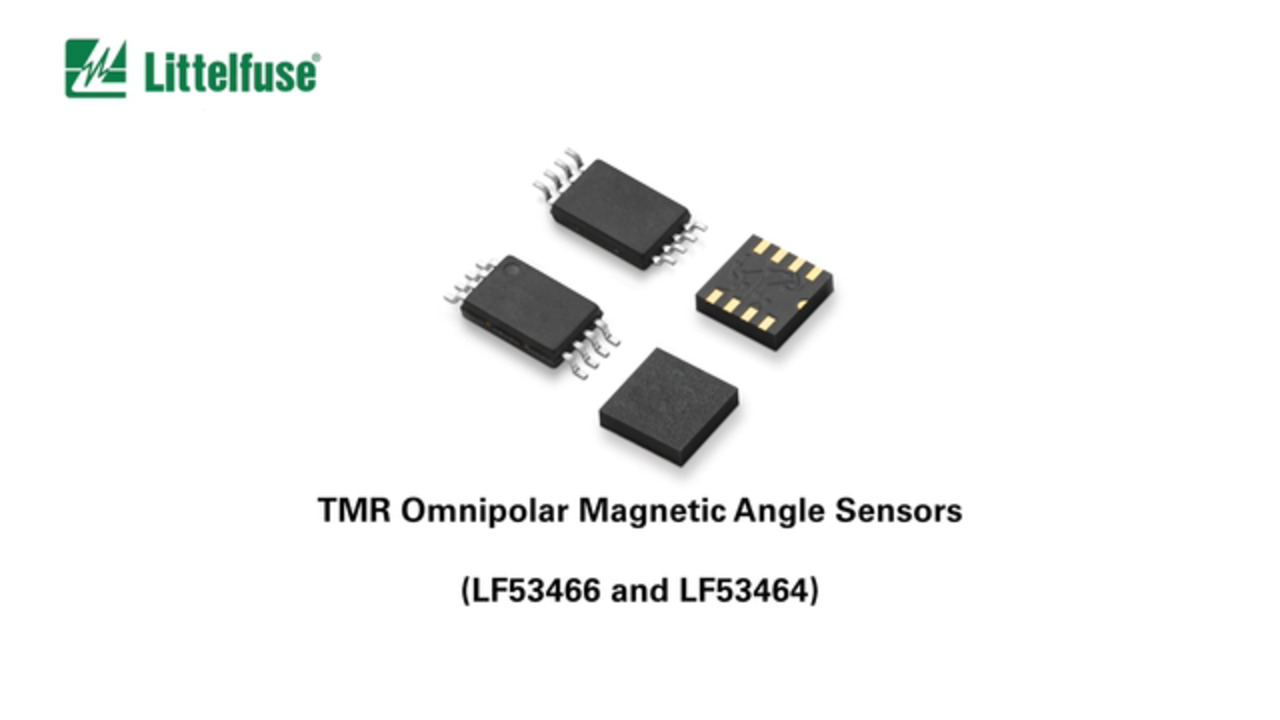
For example, Littelfuse offers the LF53464-08TMR and the LF53466-08TMR analog-output angle sensors that provide differential sine and cosine voltage signals corresponding to the 360° rotation of a nearby magnet to allow precise angle measurement. The ratiometric output architecture also improves robustness to maintain accuracy despite changes in supply voltage and magnetic field strength.
Inside Littelfuse omnipolar magnetic sensors
The core of Littelfuse LF53464-08TMR and LF53466-08TMR angle sensors is two complete and independent Wheatstone bridges that are physically oriented at a 90° angle to each other on the silicon die. The arrangement enables one bridge to measure the magnetic field component along an X-axis while the other measures the component along a perpendicular Y-axis. This two-dimensional measurement is essential to determine the direction of the magnetic field vector in the plane of the sensor.
Each bridge is in a push-pull configuration that integrates four high-sensitivity TMR elements (Figure 1). In a Wheatstone bridge circuit, a push-pull design is used to maximize the output signal in response to the stimulus, in this case, the direction of the magnetic field. As the field direction changes, the resistance of the TMR elements varies.
 Figure 1: Littelfuse’s LF53464-08TMR and LF53466-08TMR angle sensors’ functional block diagram. (Image source: Littelfuse)
In this configuration, two of the four TMR elements in the bridge are oriented to increase their resistance while the other two are oriented to decrease their resistance. This coordinated, opposing change in resistance across the bridge generates a large differential voltage output, which is a key factor behind the high-voltage output specifications of these sensors.
When a diametrically polarized magnet rotates around the sensor, the orthogonal arrangement of the two bridges produces two different analog output signals. One changes in proportion to the cosine of the magnet’s angle and the other to the sine. The differential nature is a direct result of the Wheatstone bridge topology.
Instead of a single output referenced to ground, each bridge provides a pair of outputs. The useful signal is the voltage difference between the positive and negative terminals. This differential signaling scheme is beneficial in an electrically noisy environment as it provides common-mode noise rejection.
Thermal stability and signal integrity
Temperature change is a primary source of error in precision position measurement systems. It affects the permanent magnet, whose field strength varies with temperature. Within the sensor, the base resistance and magnetoresistive response of the TMR elements are also temperature-dependent.
The Littelfuse LF53464-08TMR and LF53466-08TMR have thermal stability, allowing the sensor to adjust to ambient temperature changes. The LF53466-08TMR is engineered for harsh environments with an operating temperature range of -40°C to +150°C. This high temperature capability is a requirement for automotive applications and industrial processes. It comes housed in a TSSOP8 package.
The LF53464-08TMR is specified for a more moderate operating temperature range of -40°C to +85°C, which is suitable for most consumer and standard industrial environments. It is housed in a compact 3 x 3 mm leadless LGA8L package, which is ideal for space-constrained designs. The choice between the two depends on the requirements of environmental resilience and a package suited for the available PCB real estate.
 Figure 2: Littelfuse’s LF53466-08TMR angle sensor. (Image source: Littelfuse)
In addition to thermal stability, the dual Wheatstone bridge architecture offers improved noise immunity. The noise from motors or switching regulators coupled onto signal lines is canceled out by the differential voltage. This preserves the integrity of the angle information for a better signal-to-noise ratio and a more accurate final measurement.
Both sensors provide a high output signal. The LF53464-08TMR specifies a typical peak output voltage of 340 mV/V, which means a peak-to-peak differential swing of 680 mV/V, while the LF53466-08TMR has a typical peak-to-peak swing of 600 mV/V. On a 5 V supply, this becomes a robust signal of over 3 V peak-to-peak. This large intrinsic signal can significantly simplify or even eliminate the need for an external analog front-end (AFE) amplification stage.
Application-driven sensor differentiation
The requirements for position sensing depend on the application.
Safety-critical automotive systems: Applications such as automotive steering and pedal position require the highest levels of reliability and robust performance under extreme conditions. These systems must operate across wide temperature ranges and maintain accuracy despite electric noise and thermal variations. The LF53466-08TMR is designed for this domain. It supports a wide operating temperature range of -40°C to 150°C, which is vital for near-powertrain placement. The leaded packaging facilitates automated optical inspection required in automotive quality control.
Industrial automation and motion control: In industrial systems such as valve position sensing and rotary encoders, the emphasis is on precise angular feedback. TMR sensors are ideal for making absolute encoders that provide exact angular position over 360° without returning to a zero point. For a high-resolution encoder in a temperature sensitive application, the LF53464-08TMR’s higher typical accuracy (0.6° vs. 0.8° for the LF53466) and lower power consumption might be advantageous.
While Littelfuse’s LF53464-08TMR and LF5346-08TMR offer compelling performance advantages, engineers must understand the design tradeoffs to successfully integrate them into a final product. A primary consideration is that these are analog-output sensors that provide raw sine and cosine voltage signals, and they delegate the entire angle reconstruction calculation to an external MCU. The designer must allocate MCU resources to continuously sample the two analog channels and execute the computation in software.
Conclusion
Modern angular position sensing requires extremely high accuracy and reliability in real-world conditions. Omnipolar magnetic sensors combine contactless operation with differential outputs and thermal stability, providing a balance between signal integrity, durability, and design complexity, yielding a more resilient and scalable position-sensing architecture.
To learn more, visit Littelfuse omnipolar magnetic sensors.
Disclaimer: The opinions, beliefs, and viewpoints expressed by the various authors and/or forum participants on this website do not necessarily reflect the opinions, beliefs, and viewpoints of DigiKey or official policies of DigiKey.