Settings
 Fast Delivery
 Payment Types


 Marketplace Product

Designing Reliable Interconnects for Space Electronics
2026-09-14
Spacecraft depend on electrical interconnects to carry power, sensitive data, and RF signals between subsystems, while also needing to continue operating during launch vibration and shock, vacuum, thermal cycling, and extended periods without access for repair.
These conditions make it more challenging to maintain interconnect reliability. Vibration can disturb contact interfaces and stress cable terminations, vacuum can cause materials to outgas, and repeated temperature changes can alter mechanical structures. The selection of spacecraft interconnects depends on contact mechanics, the materials used, shielding, and mechanical retention.
Cinch Connectivity Solutions addresses these requirements through its Space Mission Solutions portfolio of interconnect, cable, and RF technologies. The portfolio builds on more than six decades of spaceflight experience, with Cinch connectors used since the early days of NASA and integrated into space telescopes, the International Space Station, and Mars rovers.
High-density connectivity
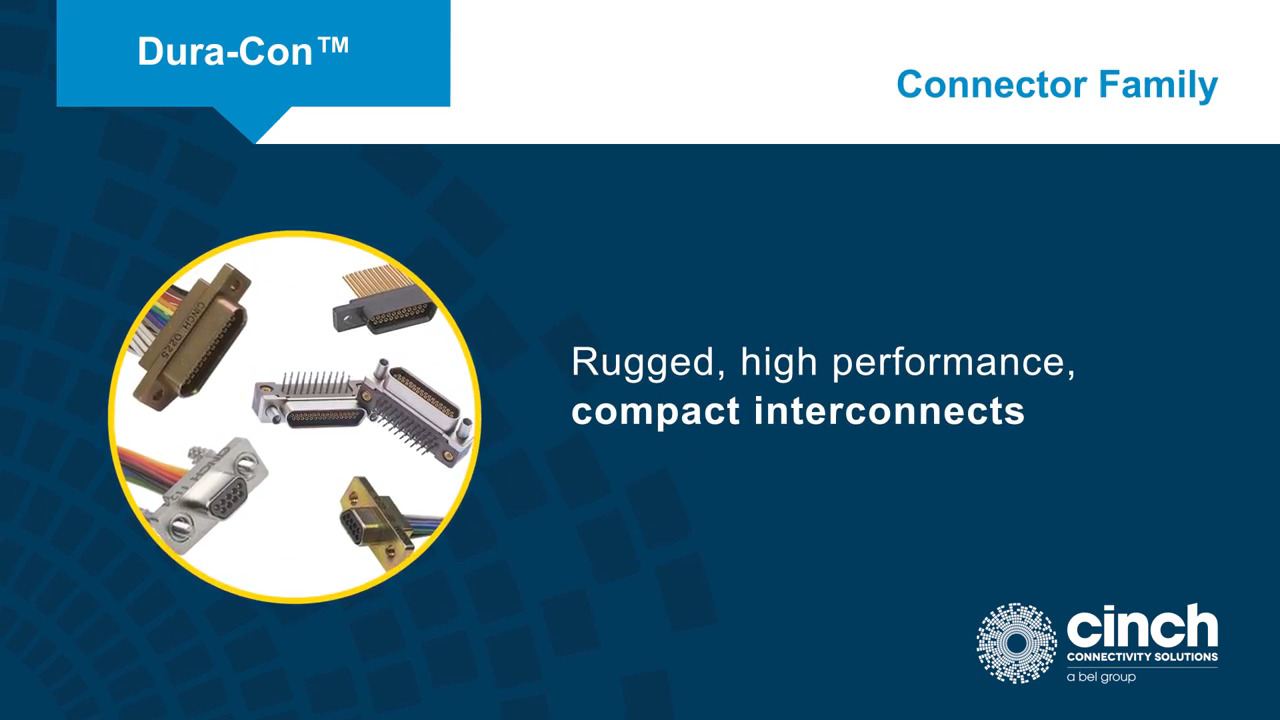
Space electronics often have many electrical connections within a limited volume and mass budget. Cinch’s Dura-Con Micro-D connectors offer cable-to-equipment and board-level connections with contacts on a 0.050 inch (1.27 mm) pitch. Space-screened versions are available with up to 100 contacts to allow multiple power, control, sensor, and other signal connections.
The key feature of Dura-Con is its twist-pin contact. The pin uses a compliant spring structure that creates seven points of contact against the socket. When the connector experiences small movements due to vibration or dimensional changes, the spring structure maintains contact pressure at these locations. This is important during spacecraft launch because any movement at the mating interface can produce changes in contact resistance, causing temporary interface discontinuities.
These connectors combine the twist-pin contact system with an aluminum-alloy housing, gold-finished copper-alloy contacts, glass-reinforced insulating materials, and ETFE insulated wire.
The metal housing provides a structural path around the contact field and contributes to EMI shielding when properly bonded. The Dura-Con connectors also use low-outgassing materials with less than 1 percent total mass loss (TML) and 0.1 percent collected volatile condensable material (CVCM).
Cinch’s CIN::APSE stacking connectors solve a different packaging problem: connections within densely packed electronic assemblies. The connectors are a solderless Z-axis compression system that connects contact pads on opposing PCBs. The contact elements have a resilient wound-wire structure that compresses between the mating surfaces to create multiple electrical contact points.
The short contact paths offer low resistance and inductance, making them suitable for dense connections. Multiple contacts within a single array can be allocated to these functions, reducing the need for separate connector bodies in a board stack. Stacking jumpers can also connect coplanar, right-angle, folded, or intermediate board arrangements.
Preserving signal integrity
Spacecraft interfaces are defined by how a signal travels between subsystems. Signal paths carrying differential data or sensitive measurements need the connector and cable to preserve conductor geometry, impedance, and shielding.
Cinch’s Trompeter Twinaxial and Triaxial connectors provide these controlled signal paths. Twinaxial connections use two inner conductors within a common outer shield, making it suitable for balanced or differential signaling. As the receiver responds to the voltage difference between the two conductors, noise coupled on both lines can be rejected as common-mode interference. The surrounding shield provides another barrier against electromagnetic fields.
Triaxial adds a concentric conductive layer that allows additional separation among the signal, guard, and outer shielding functions. It is important to maintain such an architecture because a discontinuity in conductor spacing can change the local impedance and reflect part of the signal.
Trompeter connectors use mechanically retained bayonet or threaded interfaces. Cinch also offers fixed-length cable assemblies to include 78Ω twinaxial configurations so the cable and connector can be treated as part of the same transmission path.
Where a signal has to cross a sealed barrier, Cinch offers Dura-Con Hermetic Micro-D connectors. A hermetic connector limits gas leakage across the electrical feedthrough. Some configurations are qualified to specific leak-rate requirements, enabling signal transmission across pressure differentials or controlled-atmosphere boundaries.
These products are part of Cinch's MIL-STD-1553B physical layer offering. MIL-STD-1553B uses a 1 Mb/s, command/response, dual-redundant data bus in which a bus controller coordinates communication with connected terminals. The balanced transmission line, couplers, stubs, connectors, and terminations determine the electrical behavior of the bus.
Managing RF performance and cable reliability
Cinch Space Mission Solutions portfolio extends into the RF signal path through Midwest Microwave Qualified Parts for Space (QPS). These passive attenuators are for spacecraft RF and microwave systems where signal levels and impedance need to remain controlled across communications, telemetry, sensing, and other high-frequency circuits.
An RF attenuator reduces signal power by a specified amount (expressed in decibels). For example, a 3 dB attenuator reduces the output power to approximately half of the input, while 10 dB reduces it to one-tenth. This loss can be used to obtain specific drive levels, protect sensitive receiver inputs, manage gain across an RF chain, or improve the impedance match.
The QPS attenuators operate from DC to 18 GHz, with an operating temperature range of -55°C to +125°C. Their materials meet ASTM E595 low outgassing criteria of no more than 1 percent total mass loss (TML) and 0.1 percent collected volatile condensable material (CVCM). These characteristics allow an attenuator to maintain predictable loss and impedance while also meeting the materials and screening requirements.
The connector is only one part of a reliable spacecraft interconnect. At the point where a flexible cable bundle enters a rigid Dura-Con Micro-D connector, vibration can transfer bending and tensile loads on individual conductors and their terminations. Cinch's Micro-D Backshells provide relief by transferring more of this mechanical load onto the connector shell and mounting structure.
EMI backshells also provide a means to terminate the cable braid around the conductive backshell. This continues the cable shield toward the connector housing while the backshell also controls the cable entry and provides mechanical protection.
Conclusion
Spacecraft interconnect reliability depends on maintaining electrical continuity, preserving contact stability, signal integrity, shielding, and mechanical support. Cinch’s Space Mission Solutions portfolio shows how spacecraft connectivity has to be considered as a complete electrical and mechanical system, with each component selected for the specific signal, packaging, environmental, and reliability requirements.
For more information, visit Cinch’s Space Mission Solutions.
Disclaimer: The opinions, beliefs, and viewpoints expressed by the various authors and/or forum participants on this website do not necessarily reflect the opinions, beliefs, and viewpoints of DigiKey or official policies of DigiKey.