Settings
 Fast Delivery
 Payment Types


 Marketplace Product


Build High-Performance AI Servers with Advanced Passive Components
A recent outing to the movie theater, oddly enough, got me thinking about AI servers. The movie had a tiny cast of just two main characters, but a comparatively massive credits list running into the hundreds. This reminded me of increasingly sophisticated AI servers and their star casts of GPUs and CPUs; without the support of a wide array of passive components, those processors can’t deliver all that much.
Consider the typical AI server motherboard (Figure 1). The power supply needs to be stepped down into stable, noise-free voltages. High-speed signals race between chips and network interfaces, and each link requires well-controlled timing. Overseeing it all, the baseboard management controller (BMC) monitors temperatures to keep heat under control.
 Figure 1 : An AI server motherboard requires a sophisticated selection of passive components. (Image source: Murata)
Each of these functional domains (power delivery, noise suppression, signal timing, and thermal management) depends on a carefully selected mix of passive components to achieve the necessary efficiency and reliability. Murata Electronics offers a wide range of high-performance passives for AI servers that fit neatly into each of these roles.
Capacitors and inductors keep power rails steady
Every DC/DC converter stage needs local capacitance to hold its rail steady during load steps, to filter switching noise, and to provide local decoupling. The GRM32EC80E337ME05L surface-mount multilayer ceramic capacitor (MLCC) handles all three tasks in a compact footprint, packing 330 microfarads (µF) of capacitance into a 1210 (3225 metric) case measuring 3.20 × 2.50 millimeters (mm). It is rated at 2.5 volts, matching the low-voltage rails in server power networks. Its X6S temperature characteristic holds capacitance within ±22% across the full -55 to 105°C range, so performance doesn’t sag as the board heats up.
Capacitors stabilize the rails, while inductors perform the actual voltage conversion by storing and releasing energy during each switching cycle. What sets the 2.2 microhenry (µH) DFE322512F-2R2M=P2 inductor apart is its shielded metal-alloy core, which carries high current in a compact, low-profile body and contains stray flux on tightly packed boards. The device is rated for -40 to 125°C, comes in a 1210 (3225 metric) footprint, and handles up to 2.6 amperes (A) of continuous current. Its higher 3.4 A saturation current provides headroom for the brief spikes that a busy processor rail draws, while a low 66 milliohm (mΩ) DC resistance (DCR) keeps conversion efficiency high.
Ferrite beads and filters tame switching noise
High-speed switching inevitably generates electromagnetic interference (EMI) that couples into nearby rails and signal lines. Ferrite beads tackle this by presenting high impedance to noise while passing DC current with little loss. Consider the BLM31KN601SN1L, a power-line type with 600 Ω impedance at 100 megahertz (MHz), plenty to suppress switching harmonics while presenting just 38 mΩ of DCR. It handles 2.9 A in a tiny 1206 (3216 metric) 3.20 × 1.60 mm package.
Where a single bead isn’t enough, such as a high-current feed into a sensitive subsystem, a dedicated EMI suppression filter module provides stronger attenuation. For example, the BNX023-01L inductor-capacitor (LC) filter combines inductance and capacitance in a single surface-mount device (SMD) to achieve a fifth-order low-pass response. The filter is rated for 20 A and 100 volts and achieves 35 decibels (dB) of attenuation from 1 MHz to 1 gigahertz (GHz), which is sufficient to cover the switching fundamentals and harmonics while maintaining a low channel resistance of 0.43 mΩ.
Crystal units deliver precise timing for chips and networks
Timing circuits can face extreme temperatures, especially when situated near the CPU/GPU complex. This is no problem for the XRCGA27M000FBA1BR0 crystal unit, which runs at 27 MHz with ±15 parts per million (ppm) frequency tolerance at 25°C and ±35 ppm frequency stability. The part has an operating temperature range of -40 to 125°C and comes in a 2.0 × 1.6 × 0.7 mm SMD package.
In contrast, the Ethernet physical layer (PHY) transceiver is cooler but requires a more precise reference to ensure accurate packet timing. The 25 MHz XRCGB25M000F1SBAR0 fits here. It provides tighter frequency control, with ±10 ppm tolerance at 25°C and ±20 ppm stability. The family uses the same package as its XRCGA sibling but with a lower operating temperature range of -40 to 105°C, making it better suited to the cooler board edge. Its 6 picofarad (pF) load capacitance matches the PHY’s timing circuit.
Thermistors guard against overheating
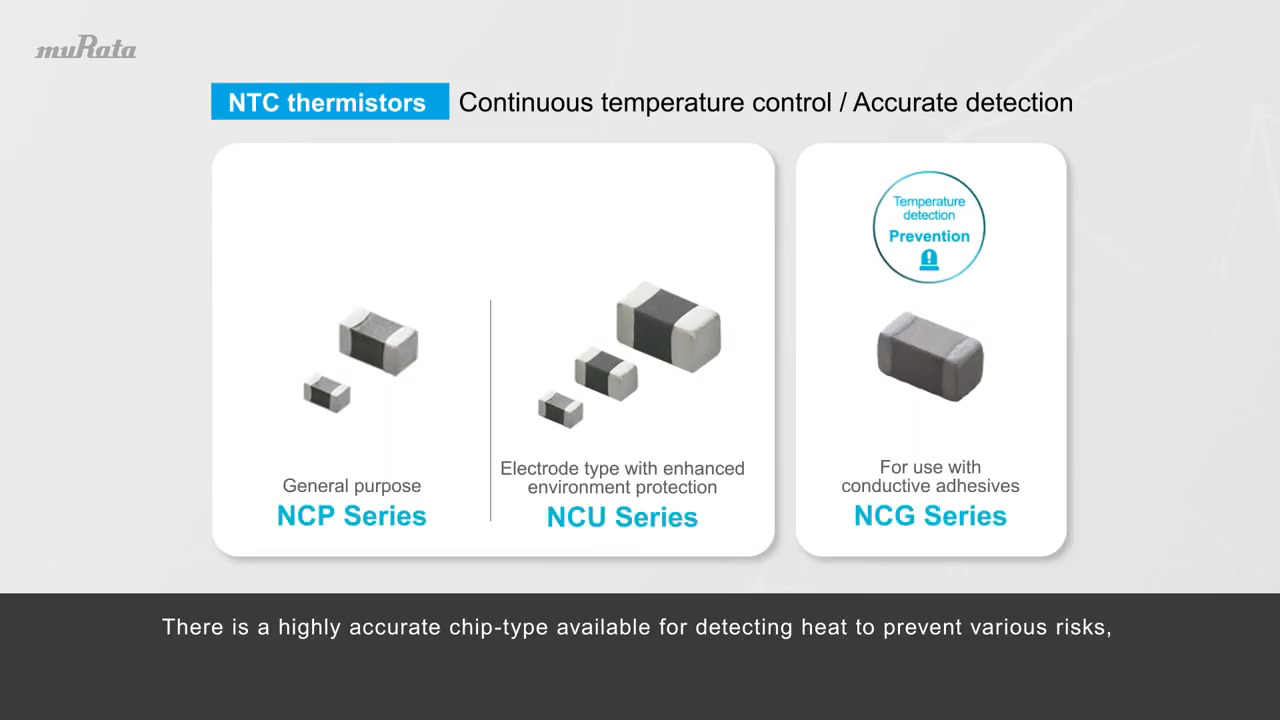
The BMC relies on accurate temperature data to manage fan speeds, issue thermal warnings, and protect the system under load. Murata’s NCU15WB473F6SRC negative temperature coefficient (NTC) thermistor provides this sensing. The device has a nominal resistance of 47 kilohms (kΩ) at 25°C, a B-Constant (25/50°C) of 4050K, and a tolerance of ±1% over its operating temperature range of -55 to 150°C (Figure 2), so the BMC can read temperature precisely without per-unit calibration. The thermistor comes in a 0402 (1005 metric) package and is suitable for placement near power integrated circuits (ICs), DC/DC converters, and other hot spots.
 Figure 2 : The NCU15WB473F6SRC NTC thermistor has a tolerance of ±1% over its operating temperature range of -55 to 150°C. (Image source: Murata)
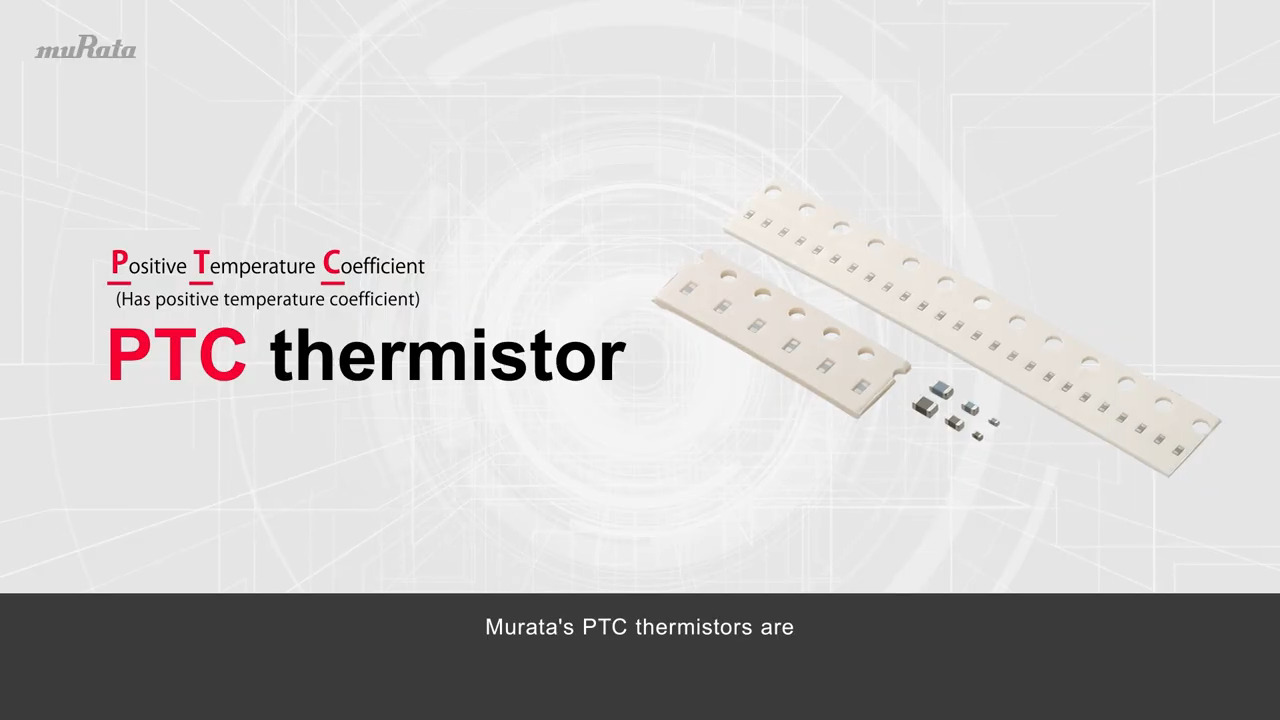
While NTC thermistors report temperature to the BMC, positive temperature coefficient (PTC) thermistors deliver direct, component-level overheat protection. Murata’s Posistor PRF15BB102RB6RC PTC sharply increases its resistance above a threshold temperature, helping protect nearby field-effect transistors (FETs) or power ICs from overheating, with no external controller required. The PTC has a resistance of 1 kΩ at 25°C and comes in a 0402 package, compact enough to sit beside individual power ICs. Its operating range is -40 to 140°C.
Conclusion
AI servers require high-performance, high-precision passives that can operate efficiently and reliably under challenging environmental conditions. Murata’s MLCCs, power inductors, ferrite beads, EMI filters, crystal units, and thermistors are engineered to meet these requirements. The GPUs and CPUs may be the stars, but it’s the passives working behind the scenes that support their performance.
About this author

Kenton Williston received his B.S. in Electrical Engineering in 2000 and started his career as processor benchmark analyst. Since then he worked as an editor with the EE Times group and helped launch and lead multiple publications and conferences serving the electronics industry.

Have questions or comments? Continue the conversation on TechForum, DigiKey's online community and technical resource.
Visit TechForumMore Blogs from this Author