Settings
 Fast Delivery
 Payment Types


 Marketplace Product


FPGAs Help Designers Keep Pace with AI and Robotics
Future-proofing applications is crucial in the fast-moving world of artificial intelligence (AI) and robotics. Choosing a system-on-chip (SoC) today too often means betting that a robot won’t need a different camera interface, a faster AI model, or an extra motor axis two years from now. Altera aims to break this cycle with silicon that product teams can treat as an adaptable layer in the system architecture.
A robot that enters production with one camera, one AI model, or a fixed number of motion axes may later need to support new sensors, faster inference, tighter latency, or additional safety requirements before the next product generation. That makes architecture choice more than a hardware decision; it becomes a way to preserve room for change. The most successful robot designs will be those that adapt with richer perception, faster motion control, and more autonomous decision-making.
Altera field programmable gate array (FPGA) SoCs for robotics provide an adaptable compute foundation that product teams can evolve as AI models, sensors, and automation requirements change. Rather than locking product designers into a fixed architecture, they provide room to refine performance, add interfaces, and respond to new system demands over time.
Altera’s Robotic Solutions Stack is intended to reduce that integration burden by bringing together FPGA hardware platforms, software, IP, and design resources for robotics development. It provides an ecosystem encompassing scalable AI acceleration, consolidated robotics control, multi-axis motor control (Drive-on-Chip), and functional safety support, giving product designers a more complete starting point for systems that need to adapt over time. They'll be able to spend less time assembling the pieces and more time focusing on what makes the robot perform, adapt, and scale.
The DK-A5E065AB32AEA Agilex 5 E-Series 065B modular development kit (Figure 1) illustrates that flexibility for practical robotics applications, providing a complete hardware and software development platform to help designers combine AI, control, and real-time response in a single platform. The kit combines an Agilex 5 E-Series SoC FPGA with integrated Arm processors, high-speed connectivity, DDR4 memory, and modular expansion capabilities.
 Figure 1: The DK-A5E065AB32AEA Agilex 5 E-Series FPGA development boards provide complete reference development platforms to support robotics design teams. (Image source: Altera)
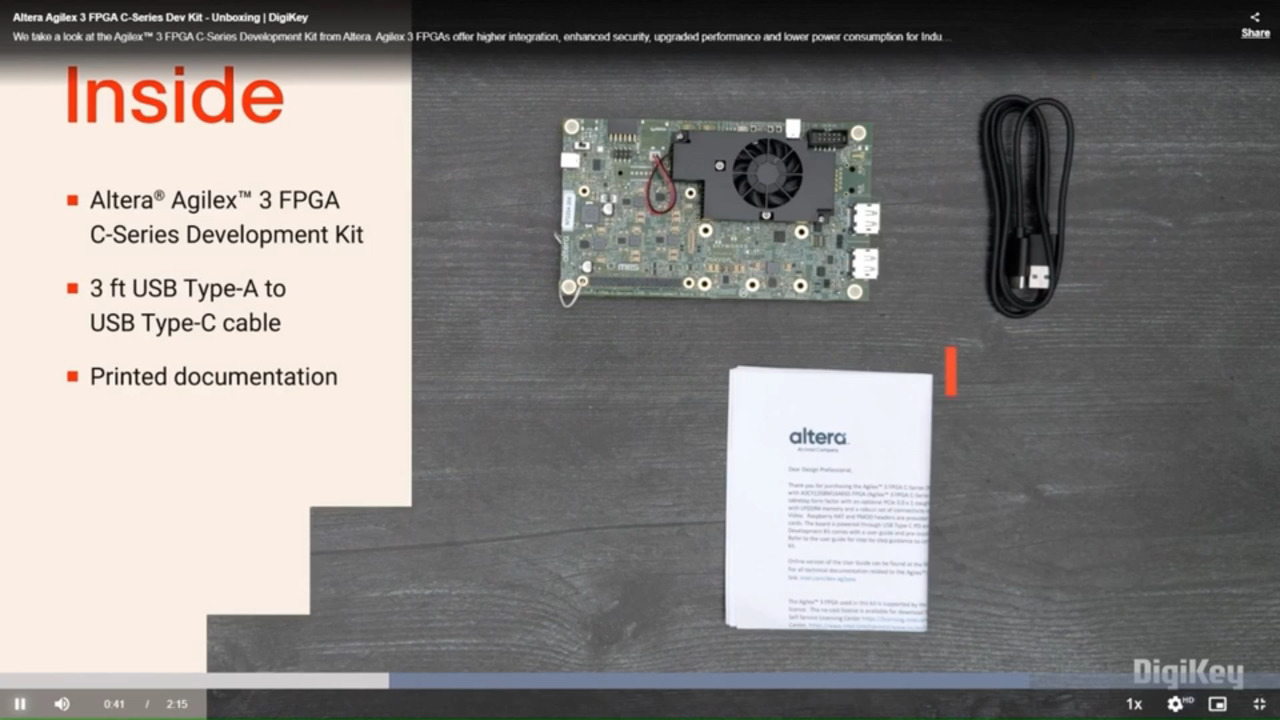
Altera also offers Agilex 3 C-Series development kits such as the DK-A3W135BM16AEA (Figure 2). Together, the Agilex 3 C-Series and Agilex 5 E-Series platforms offer developers FPGA options ranging from cost-optimized edge designs to higher-performance robotics, AI, and industrial applications.
 Figure 2: Agilex 3 C-Series development boards are suited for cost-optimized robotic application designs. (Image source: Altera)
Accommodating multiple design objectives
Platform range matters because not every robotics program will start from the same design point. Some teams may be optimizing for compact edge deployment, while others need more processing headroom for advanced perception, coordinated motion, or industrial networking. Having multiple FPGA platform options helps designers match the architecture to the product instead of forcing the product to fit a single compute approach.
Those platform choices point to a larger shift in how robotics systems may be designed. In what Altera describes as its “FPGAi” vision, those platforms are intended to bring programmable logic and AI closer together so designers can add intelligence where it fits best, without giving up the flexibility to evolve. The goal is to enable designs that can reshape themselves as workloads change.
That flexibility carries into Altera’s Drive-on-Chip approach, which uses Agilex 5 devices to bring motion control and safety functions closer together in the FPGA. Instead of spreading logic, safety, and drive control across multiple DIN-rail components, designers can consolidate more of the system in silicon, resulting in a reduced footprint, simplified integration, and faster real-time response.
Robotics platforms rarely remain static after launch. A design may need to be tuned for a different factory layout, updated for a new perception model, or adapted for another payload or motion profile. By preserving more flexibility in the compute architecture, FPGA-based systems can help teams respond to those changes without starting over at the board level.
For product designers, the appeal is not just more compute, it is design flexibility over the full life of the robot. A platform that can adapt to new sensors, updated AI models, additional axes of motion, or changing safety requirements can help teams reduce redesign risk and extend the usefulness of their architecture across multiple product generations.
Conclusion
Altera FPGA SoCs, supported by the robotic solutions stack and Drive-on-Chip, give teams a path to build systems that are fast, deterministic, and adaptable enough to keep pace with changing robotics requirements.
About this author

Pete Bartolik is a freelance writer who has researched and written about IT and OT issues and products for more than two decades. He previously was news editor of the IT management publication Computerworld, editor-in-chief of a monthly end-user computer magazine, and a reporter with a daily newspaper.

Have questions or comments? Continue the conversation on TechForum, DigiKey's online community and technical resource.
Visit TechForumMore Blogs from this Author