Settings
 Fast Delivery
 Payment Types


 Marketplace Product


Modern Product Performance Depends on Passive Power Delivery Components
Designers striving to improve battery life, increase processing capability, or reduce electromagnetic interference (EMI) often discover that power delivery has become a limiting factor. Increasingly, product performance ultimately depends on how effectively power is delivered, filtered, stored, and managed throughout the design. That’s where passive power-conversion components play a critical role behind the scenes.
A critical evolution of power distribution networks (PDNs) across high-demand sectors—such as artificial intelligence, automotive electrification, and industrial automation—is underway. As systems encounter higher thermal density and faster load transients, traditional hardware selection is increasingly complemented by closer attention to parasitic management, thermal design, and magnetic material performance.
As AI workloads move from cloud environments into edge devices, power systems face growing demands. Sudden current spikes, tighter efficiency requirements, and increased thermal constraints place greater emphasis on power conversion and conditioning. Some of the system constraints that designers must navigate include:
- Switching frequencies and load transient speeds continue to rise, requiring the PDN to manage fast load transients across multiple frequency ranges.
- EMI sensitivity is now a critical concern. Because voltage conversion happens in stages, PDN behavior is cumulative across the entire system.
- Thermal density has reached a point where it severely limits component choices, forcing a move toward parts with higher ripple current ratings and lower core losses.
YAGEO Group and its subsidiary, KEMET, can help designers optimize power architectures, enabling systems to operate more efficiently and reliably through a comprehensive line of advanced passive components. These components, including capacitors, inductors, ferrites, and filtering solutions, provide many of these foundational building blocks to ensure applications maintain signal integrity, minimize noise, and deliver clean power to increasingly demanding electronics.
Passive components were once treated as commodity building blocks rather than performance-critical design elements. Resistors handled basic bleed, pull-up, and pull-down functions; capacitors provided bulk energy storage; and magnetic components were largely associated with low-frequency filtering and line choking.
The demands placed on modern electronics have fundamentally altered that viewpoint. AI workloads create sudden power spikes, edge devices pack more processing into smaller footprints, and EVs demand especially high requirements for efficiency, power density, EMI control, and reliability.
In many high-power systems, power architectures have shifted from centralized distribution with forgiving design margins toward multi-stage conversion, ranging from front-end power distribution to intermediate buses and point-of-load regulation.
As products become more intelligent, connected, and power-hungry, the role of passive components becomes increasingly critical. A network of passive components quietly determines how efficiently, reliably, and effectively the product performs. They affect everything from processing performance and signal integrity to battery life, thermal management, and system reliability.
With power budgets tightening and performance expectations growing, passive components have become strategic design levers that determine whether a product meets its performance, efficiency, and reliability goals. In many cases, the difference between a product that merely functions and one that excels can be traced to the quality and effectiveness of the passive components that support its design.
Whether supporting AI infrastructure, industrial automation, EV power electronics, or next-generation consumer devices, these components increasingly determine how efficiently, reliably, and effectively power moves through modern systems. YAGEO/KEMET solutions demonstrate how passive components have evolved from commodity parts into performance enablers.
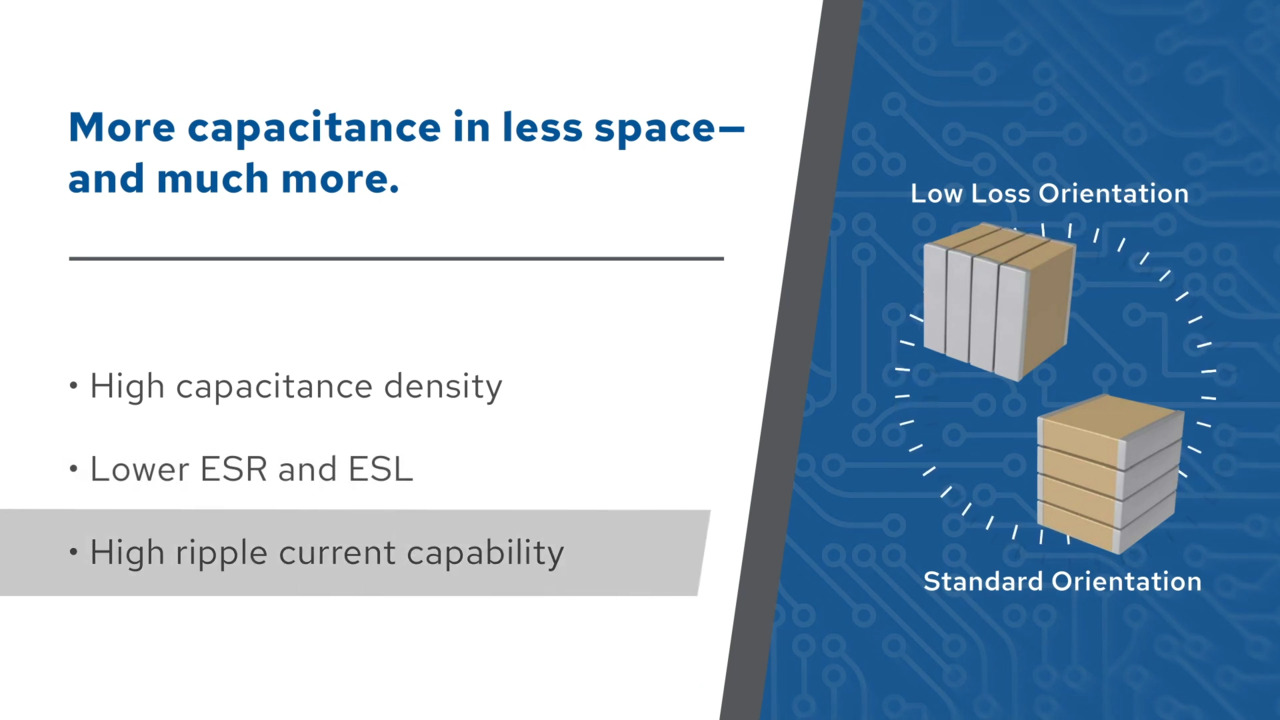
- KEMET’s KC-LINK™ capacitors (Figure 1) help designers manage high ripple currents and switching frequencies without sacrificing board space or efficiency.
 Figure 1 : KEMET KC-LINK surface mount capacitors feature a broad range of voltage and capacitance options. (Image source: YAGEO Group/KEMET)
- In compact, power-dense systems, METCOM MPX metal composite inductors (Figure 2) enable more efficient power conversion while helping designers control electromagnetic interference and thermal performance.
 Figure 2: METCOM MPX metal composite inductors feature a metal core with high saturation characteristics and can be used as both power inductors and EMI filter inductors in DC/DC switching power supplies. (Image source: YAGEO Group/KEMET)
- KEMET’s SCF-XV, SCR-XV, and SCT-XV common-mode choke families are designed to meet the stringent EMI and reliability requirements of EV power electronics and industrial automation systems.
- For energy storage, KEMET’s T598 and T599 automotive polymer capacitor families and A781 hybrid aluminum polymer capacitors are helping designers improve power-system stability, efficiency, and reliability in increasingly demanding environments.
Conclusion
As power becomes the defining constraint of next-generation design, passive components are stepping into a leading role. The future belongs to products that can do more with every watt, and increasingly, that future will be shaped by the technologies quietly managing power behind the scenes. YAGEO and KEMET are helping engineers address the efficiency, reliability, and power-density challenges of increasingly sophisticated systems through innovations in capacitors, inductors, chokes, and other power-conversion technologies.
About this author

Pete Bartolik is a freelance writer who has researched and written about IT and OT issues and products for more than two decades. He previously was news editor of the IT management publication Computerworld, editor-in-chief of a monthly end-user computer magazine, and a reporter with a daily newspaper.

Have questions or comments? Continue the conversation on TechForum, DigiKey's online community and technical resource.
Visit TechForumMore Blogs from this Author