Settings
 Fast Delivery
 Payment Types


 Marketplace Product


The Invisible Technology Keeping AI Data Centers Alive
As AI models grow larger and data centers consume more power than ever before, a critical question emerges: How do you keep thousands of servers running without interruption?
There is a growing challenge of powering AI infrastructure reliably as data centers evolve from traditional AC architectures toward high-voltage DC designs. LEM's sensors become the "nervous system" that provide visibility, protection, efficiency, and control across the entire power chain.
The architecture graphic highlights every major segment of modern AI data center power delivery, from grid infrastructure and backup power systems to power distribution, conversion, and cooling systems.
When most engineers think about AI infrastructure, they picture GPUs, networking equipment, and massive server racks. What often goes unnoticed is the power system working behind the scenes.
Yet without it, artificial intelligence doesn't exist.
Every AI inference, every model training run, and every cloud service depends on an intricate chain of power conversion, distribution, backup systems, and cooling infrastructure. The challenge is no longer simply delivering electricity. Modern data centers must do so efficiently, safely, and reliably while handling unprecedented energy demands. According to LEM, the evolution toward next-generation architectures places increased emphasis on accurate current measurement throughout the entire power chain.
Following Power's Journey Through the Data Center
Imagine power's journey into a modern AI facility.
It begins at the utility grid, where incoming power enters substations and transformation equipment before being routed toward the facility. From there, it moves through layers of conversion, distribution, backup systems, and cooling equipment before finally reaching the processors performing AI computations (Figure 1).
 Figure 1: LEM’s data center power architecture graphic shows how current sensing supports grid infrastructure, backup power, distribution, conversion, and cooling systems across evolving AI data center designs. (Image source: LEM USA, Inc.)
At every stage, engineers need answers to critical questions:
- How much current is flowing?
- Is equipment operating efficiently?
- Is there a fault developing?
- Is leakage current present?
- Are backup systems ready when needed?
Those questions can only be answered through precise sensing.
LEM's current sensing technologies support the entire chain, from grid infrastructure and backup power systems to power distribution, power conversion, and cooling equipment.
Five Places Where Current Sensing Matters Most
1. Grid Infrastructure - Before power reaches servers, operators need precise current measurements in medium-voltage conversion systems. LEM positions its sensors for input and output measurements that help engineers monitor performance and system health.
2. Backup Power Systems - Data centers cannot afford downtime. Uninterruptible power supplies (UPS), battery energy storage systems (BESS), and battery backup units (BBUs) stand ready to respond when disturbances occur. LEM's sensing solutions help enable charge and discharge control, state-of-charge estimation, power smoothing, and fault detection.
When milliseconds matter, visibility into battery performance can determine whether an outage becomes a non-event or a headline.
3. Power Distribution - Power distribution units, busways, and branch circuits must be continuously monitored to ensure loads remain balanced and protected. LEM highlights both current sensing and Type-B residual current sensing capabilities for load measurement, leakage detection, and system protection.
4. Power Conversion - Modern power electronics increasingly rely on wide-bandgap semiconductors such as silicon carbide (SiC). According to LEM, high-bandwidth integrated current sensors help enable these switching devices within power conversion systems.
The faster the switching speeds, the more valuable accurate measurement becomes.
5. Cooling and HVAC - AI hardware generates enormous amounts of heat. That's why cooling systems have become a critical design consideration. LEM offers sensing solutions intended for variable frequency drives (VFDs) used in cooling pumps, fans, and refrigerant systems within cooling distribution units (CDUs).
Without efficient cooling, there is no reliable AI.
One Problem, Many Sensor Technologies
What's particularly interesting about LEM's portfolio (Figure 2) is the range of sensing technologies available for different design challenges.
The portfolio includes:
- Rogowski coil sensors
- Closed-loop Hall effect sensors
- Coreless integral Hall effect sensors
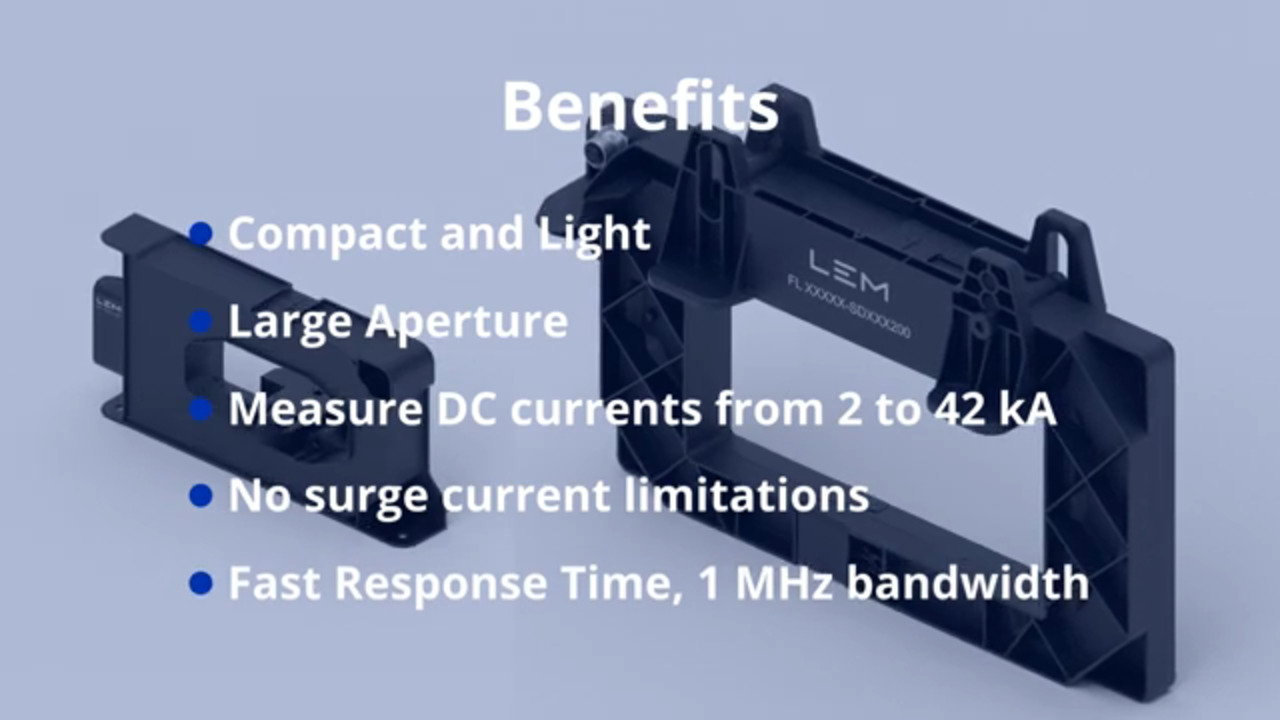
- Aperture Hall effect sensors
- PCB-mount Hall effect devices
- Fluxgate technologies
- TMR-based solutions (Tunnel Magnetoresistance)
 Figure 2: LEM’s sensor portfolio spans multiple sensing technologies and performance ranges, allowing engineers to match current measurement solutions to grid, backup power, distribution, conversion, and cooling applications. (Image source: LEM USA, Inc.)
Some designs prioritize extremely high current measurement capability. Others focus on accuracy, bandwidth, thermal performance, or compact PCB integration.
The result is a toolbox engineers can apply across virtually every layer of the data center power ecosystem.
The Takeaway
AI may be transforming industries, but the real enabler isn't just compute power. It's electrical power.
As data centers continue evolving toward higher efficiency, higher density, and next-generation architectures, engineers will need increasingly sophisticated ways to measure, monitor, and control energy flow.
Current sensors don't train AI models.
They don't generate images.
They don't perform inferencing.
But they provide the visibility needed to keep the infrastructure running that makes all of those things possible.
In the race to build faster and more capable AI systems, the most important technology may be the one quietly measuring the current behind the scenes.
About this author

A leading company in electrical measurement, LEM engineers the best solutions for energy and mobility, ensuring that their customers’ systems are optimized, reliable and safe. With 1,500 people in over 15 countries transforming technology potential into powerful answers, LEM develops and recruits the best global talent, working at the forefront of mega trends such as renewable energy, mobility, automation, and digitization. Through its innovative electrical solutions, LEM is helping customers and society accelerate the transition to a sustainable future.

Have questions or comments? Continue the conversation on TechForum, DigiKey's online community and technical resource.
Visit TechForum