Settings
 Fast Delivery
 Payment Types


 Marketplace Product


Use Matched Components to Minimize “Make versus Buy” Compromises in DC/DC Converter Designs
When designing DC/DC converters, you have traditionally faced a clear choice between two options: make them using discrete components or buy them as a complete, modular unit.
Like most engineering decisions, it’s not a clear-cut choice, as there are tradeoffs and implications associated with each path. Among the many factors that affect the decision are:
- Required voltage, current, and power levels
- Performance considerations including line and load regulation, transient response, and ripple
- Choice of internal topologies (the broad categories are full bridge, push-pull, or flyback)
- Efficiency and thermal issues
- Overvoltage, overcurrent, transient, and short-circuit protection
- Size (footprint and volume) and weight
- Regulatory restrictions, approvals, and mandates, including electromagnetic interference (EMI) limits
- Time to market and design risk
- Long-term supplier support
- In-house design expertise and available resources
- Initial cost, along with crossover implications of the volume-versus-cost curve, especially at higher volumes (typically above 50,000 units)
There’s an inherent tension between choosing a ready-made, off-the-shelf module and a do-it-yourself (DIY) design using discrete ICs and passive components. When trying to meet a given set of basic performance requirements, project teams want short development times and low project risk while also meeting difficult cost goals, thermal mandates, size constraints, and more.
You also face the DIY reality that designing a decent supply using discrete components is not hard, but designing a really good one that meets a multitude of often-conflicting goals can be very hard, especially when it comes to achieving those last few percentage points in performance. Further, when magnetics are involved, as they are in these converters, many teams may not have the specialized expertise in-house.
A third way resolves the conflict
Recognizing this discrete/modular dilemma, RECOM Power has developed an alternative approach to Discrete Power Solutions. Their “building blocks” allow you to build your own converter, while ensuring that the various blocks work together, thereby minimizing design uncertainty and risk.
This new approach recognizes that magnetic components, parasitic effects, switching transients, isolation, EMI, and more must be understood and their impacts properly balanced. This is especially true because the ripple effect of adjusting one component's specifications to improve performance often has detrimental effects elsewhere in the design.
RECOM’s discrete DC/DC architecture, based on driver IC-plus-transformer solutions, simplifies the transition from a ready-made DC/DC module to a discrete DC/DC power supply. The portfolio centers on RECOM Power ICs paired with carefully matched, pre-tested surface-mount device (SMD) transformers.
Taking a closer look
The leading DC/DC converter topologies, full bridge, push-pull, and flyback, require three key functions (Figure 1): a DC/DC transformer driver chip, a transformer (in a somewhat different role in the flyback design), and a rectifier or rectifier/regulator. The latter is typically implemented using off-the-shelf (OTS) components.
 Figure 1: Regardless of the underlying topology of a DC/DC converter, a high-level view shows three stages: transformer driver, transformer, and rectifier/regulator. (Image source: RECOM Power)
The primary-side transformer driver chip defines the topology and essential operating parameters. RECOM offers three similar units to support the dominant converter topologies:
- The RVP010-PPN-R push-pull transformer driver (Figure 2)
- The RVP001-FBN-R full-bridge transformer driver
- The RVPW011-FJ1-R current-mode regulated flyback controller IC
For example, the RVP010-PPN-R push-pull transformer driver is designed for small-form-factor, low-standby-power, isolated micropower supplies and comes in a 3.0 × 3.02 millimeter (mm) SMD SOT23-6 package.
 Figure 2: Despite its diminutive SOT23-6 package, the RVP010-PPN-R push-pull transformer driver incorporates a comprehensive set of DC/DC converter-specific functions. (Image source: RECOM Power)
You only need to add a simple set of peripheral components to the RVP010-PPN-R, including input and output filter capacitors, an isolation transformer, and a rectifier circuit, to end up with an isolated power supply with a 2.8 to 6 volt input, an output voltage ranging from 3.3 to 24 volts, and output power between 1 and 3 watts.
The RVP010-PPN-R integrates an internal oscillator that generates a pair of high-precision complementary signals to drive two N-channel switches. A symmetrical internal architecture ensures excellent balance between the two power switches, minimizing magnetic bias during operation. A high-precision dead-time control circuit is also integrated to prevent simultaneous conduction of the two power switches under all operating conditions.
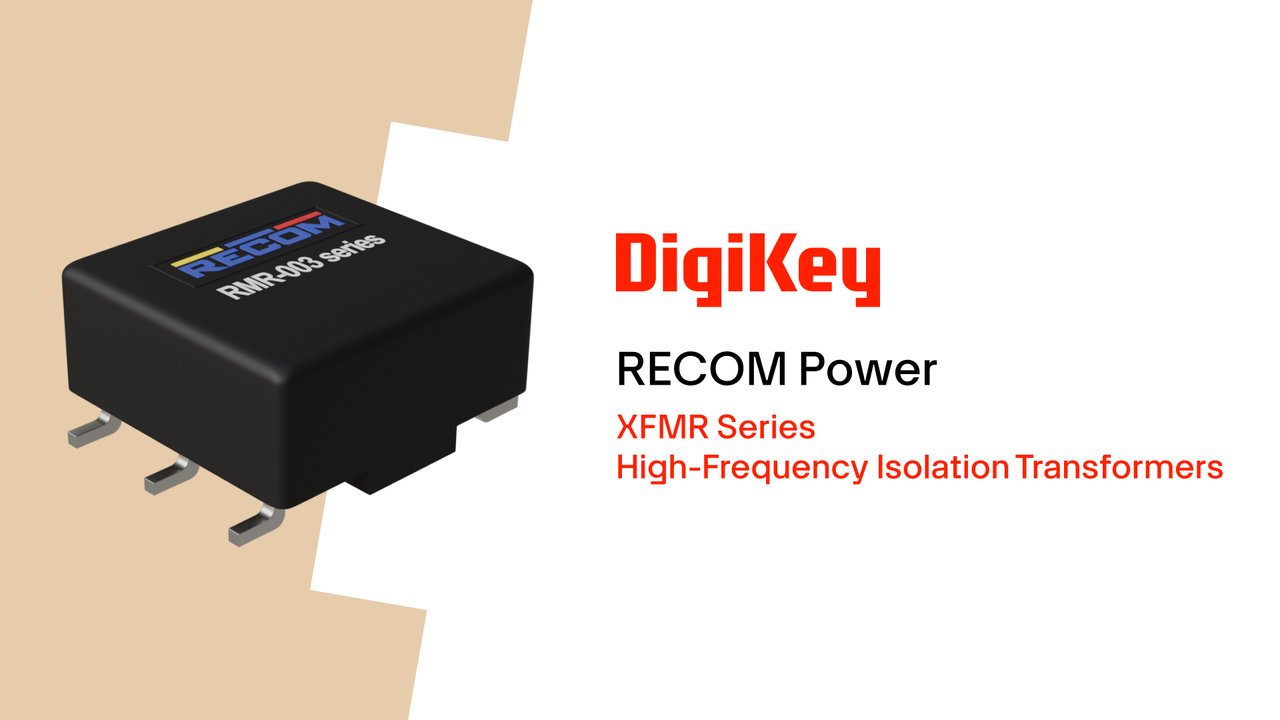
The transformer determines the output voltage or voltages and provides galvanic (ohmic) isolation. Rather than having you select a suitable transformer from the hundreds of options on the market, RECOM offers the RMR family in their XFMR series of standard SMD transformers with various turn ratios and isolation ratings, each tuned to match the needs of the RVP-series drivers and ensure compatibility.
For example, the RMR-039-A55S-R (Figure 3) is a small, 1500 volt DC (VDC) SMD isolation transformer designed to work with the RVP010-PPN-R push-pull driver. It features four windings with turn ratios of 1:1 (between primary sides) and 1:1.11 (from each primary to the secondary).
 Figure 3: The RMR-039-A55S-R transformer is designed to work seamlessly with the RVP010-PPN-R transformer driver. (Image source: RECOM Power)
These off-the-shelf magnetics help you quickly implement a power stage that reflects the efficiency of RECOM’s proven modules. Their validated pairings reduce design risk, simplify component selection, and accelerate time-to-market while optimizing cost and performance.
Finally, the secondary IC is a rectifier or rectifier/regulator that converts the transformer’s AC output to DC and, when needed, stabilizes the output voltage. The isolated DC/DC supply also includes passive components such as capacitors for signal conditioning and resistors for current limiting. These components are typically selected by the designer to meet the specific load voltage, ripple current, and other application requirements.
Conclusion
By combining modular power expertise with discrete design flexibility, RECOM Power delivers scalable, efficient power solutions. With this approach, you are no longer constrained by a modular solution or overwhelmed by discrete design options. Instead, you gain flexibility and validated compatibility among the constituent components.
About this author

Bill Schweber is an electronics engineer who has written three textbooks on electronic communications systems, as well as hundreds of technical articles, opinion columns, and product features. In past roles, he worked as a technical web-site manager for multiple topic-specific sites for EE Times, as well as both the Executive Editor and Analog Editor at EDN.
At Analog Devices, Inc. (a leading vendor of analog and mixed-signal ICs), Bill was in marketing communications (public relations); as a result, he has been on both sides of the technical PR function, presenting company products, stories, and messages to the media and also as the recipient of these.
Prior to the MarCom role at Analog, Bill was associate editor of their respected technical journal, and also worked in their product marketing and applications engineering groups. Before those roles, Bill was at Instron Corp., doing hands-on analog- and power-circuit design and systems integration for materials-testing machine controls.
He has an MSEE (Univ. of Mass) and BSEE (Columbia Univ.), is a Registered Professional Engineer, and holds an Advanced Class amateur radio license. Bill has also planned, written, and presented on-line courses on a variety of engineering topics, including MOSFET basics, ADC selection, and driving LEDs.

Have questions or comments? Continue the conversation on TechForum, DigiKey's online community and technical resource.
Visit TechForumMore Blogs from this Author