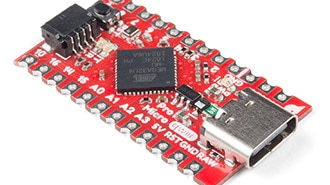
SERCOM (Serial Communication) is a multiplexed serial configuration used on the SAMD21, SAMD51 and other boards. It allows you to select various serial functions for most of your pins.
The Qwiic RFID ID-XXLA is an I2C solution that pairs with the ID-LA modules: ID-3LA, the ID-12LA, or the ID-20LA, and utilizes 125kHz RFID chips. Using the product's interrupt pin, we'll discuss how to get, store, and compare unique RFID IDs.
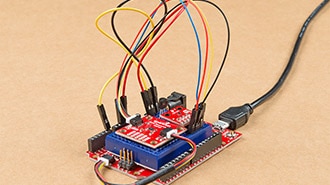
In this hookup guide, we'll connect our sensor up to our Esp32 Thing Plus microcontroller and run a of quick (Qwiic) example to get you up and running with this fantastic board!
The SparkFun Pi Servo pHAT provides your Raspberry Pi with 16 PWM channels that can be controlled over I2C. These channels are broken out in a header combination that is perfect for connecting servo motors.
The PCA9306 is a dual bi-directional voltage translator for the I2C-bus and SMBus. It works at a range of voltages between 1.2V and 5.0V and doesn't require a direction pin to function. This is a great board for shifting voltages between sensors and your microcontroller.
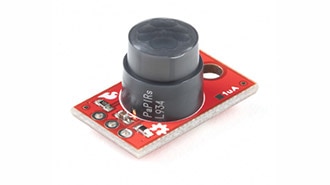
Looking to add some motion detection to a project you are working on? The SparkFun PIR Breakout - 170uA (EKMC4607112K) and SparkFun PIR Breakout - 1uA (EKMB1107112) might be just the thing!
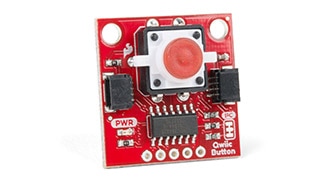
These breakouts eliminate nearly all the inconvenience of using buttons by converting everything to an easy-to-use I2C connection using the Qwiic Interface.







 Settings
 Fast Delivery
 Payment Types


 Marketplace Product