Configuración
 Entrega rápida
 Tipos de pago


 Producto del mercado

Designing High-Speed Interconnects for Automotive Systems
2026-01-14
High-speed data connectivity has become a critical constraint in modern automotive electronics as they generate enormous data streams that must be transmitted with minimal latency. Next-generation advanced driver-assistance systems (ADAS) alone demand in-vehicle networks exceeding 1 Gbps to handle high-resolution cameras and radar feeds in real time.
Similarly, infotainment and connected services are expected to deliver a smartphone-like experience, raising the bar for bandwidth and reliability in vehicle data links. These trends have created a need for reliable, high-speed interconnects that can handle harsh automotive conditions while carrying multi-gigabit data between modules.
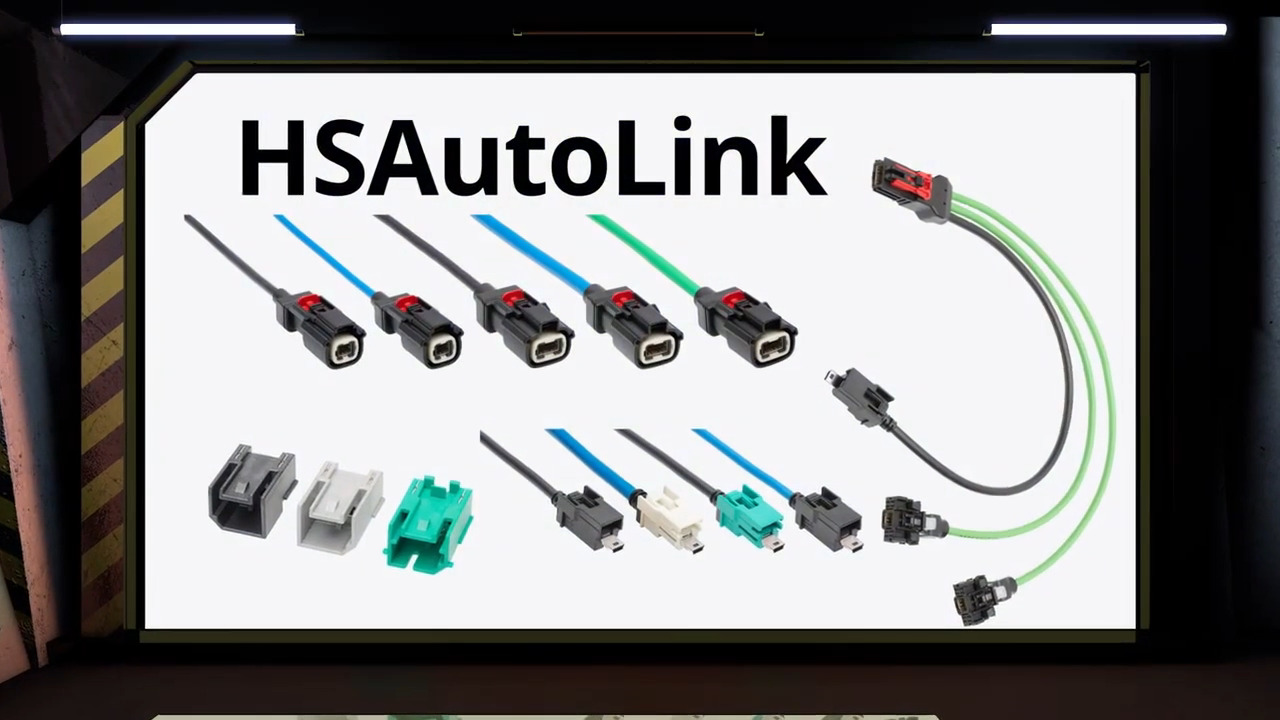
To address this need, Molex offers the HSAutoLink Interconnect System (Figure 1) for robust in-vehicle data connectivity. The HSAutoLink system is a proven, automotive-grade connector family that enables high-speed point-to-point connections for cameras, displays, sensors, and other vehicle electronics.
 Figure: Molex HSAutoLink Interconnect high-speed automotive-grade connector family for point-to-point connections. (Image source: Molex)
The genesis of the system
In the mid-2000s, as MP3 players and early smartphones began to interface with vehicles, original equipment manufacturers (OEMs) initially relied on standard consumer-grade USB connectors. However, it quickly became apparent that these connectors were prone to failure. The friction fit of a standard USB plug could not withstand the random vibration profile of a moving vehicle.
Molex addressed this by re-engineering the interface. They retained the core electrical interface of the USB but discarded the consumer-grade housing. Instead, they encased the electrical contacts in a rugged, automotive-grade shell featuring positive latching mechanisms, polarization keys, and robust shielding.
The HSAutoLink consists of mating cable assemblies and PCB headers. The cable assemblies use mini-USB style plugs and receptacles with full shielding and latching features. Corresponding board-mount headers are available in right-angle or vertical orientations, which are well-suited to tight packaging in automotive electronic control units (ECUs).
The system was first deployed in vehicle infotainment and telematics modules to bring consumer USB connectivity into the car with automotive-grade reliability. Today, HSAutoLink is used as a general-purpose data connector standard in many vehicles, supporting not just USB data but also other serial data protocols over a common interface.
A defining characteristic of the HSAutoLink system is its adherence to USCAR30. The United States Council for Automotive Research (USCAR) establishes a performance standard for automotive electrical connector systems. Compliance with USCAR30 requires passing a series of environmental tests.
Technical benefits of HSAutoLink
The engineering value of the HSAutoLink system lies in its ability to maintain signal integrity in an environment actively seeking to degrade it. The interconnect system also enhances design flexibility by supporting multiple protocols in the same connectors and being able to withstand high temperatures.
Signal integrity and connection stability
In the hierarchy of automotive failure modes, intermittent connection is among the most common. HSAutoLink connectors are designed to maintain stable electrical connections even under vibration, shock, and repeated use. Unlike standard USB, the system implements positive latching mechanisms and robust keying to prevent accidental unplugging or mis-matching.
The headers and plugs include mechanical latches and guide rails that ensure a strong connection, proven to withstand vibration and repeated service events. Molex also offers multiple polarization key options and color-coded connector housings to avoid assembly errors when multiple HSAutoLink cables are used.
The result is an interconnect system that maintains signal continuity and integrity even in high-vibration automotive environments. This far exceeds the reliability of a conventional consumer USB connector.
Operation in harsh conditions
The HSAutoLink system is built to withstand the extreme conditions encountered in vehicles, including temperature swings, moisture, and electromagnetic noise. The connectors are designed to protect connections from water, dust, and fluids in exposed locations such as under the hood or off-highway equipment. All HSAutoLink components are made from high-temperature thermoplastics and materials rated for -40°C to +105°C operation.
The cables use full-length shielding, and a fully enclosed metal case to reduce electromagnetic interference (EMI) and crosstalk in noisy electrical environments. This shielding preserves signal integrity for high-speed data even when routed alongside other wiring in the car.
More importantly, the connection between the cable shield and the connector shield is continuous. This creates a Faraday cage around the signal path, preventing external EMI from coupling onto the data lines and conversely, preventing the high-speed data signals from radiating out and interfering with the vehicle’s radio antenna.
Multiple protocol support
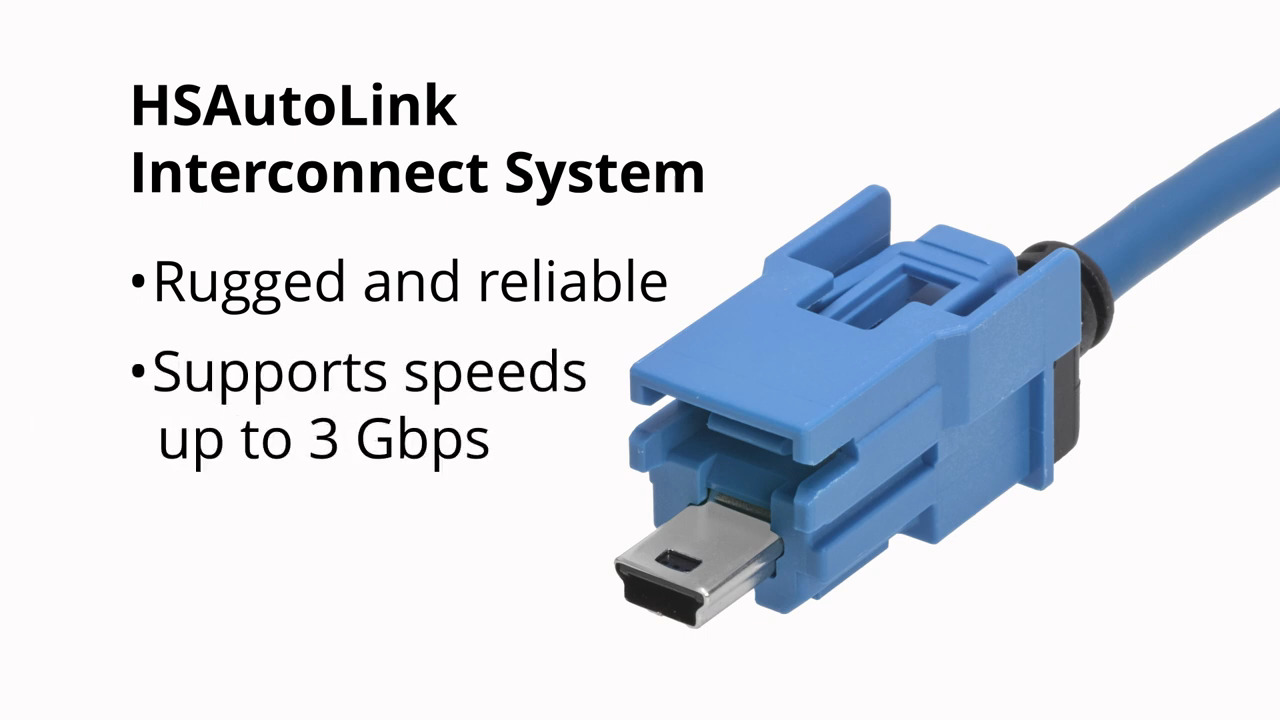
One of the core advantages of HSAutoLink is the support for a variety of high-speed data protocols. It is developed with enough bandwidth to support data rates up to 3.0 Gbps for proprietary or automotive protocols (Figure 2). This makes it suitable for carrying USB 2.0, automotive Ethernet (100Base-T1), LVDS video links, an A2B audio bus, and other serial interfaces over a common 4-pin or 5-pin connector.
 Figure 2: Molex HSAutoLink cable with data rates of up to 3.0 Gbps. (Image source: Molex)
For instance, the same 5-circuit HSAutoLink cable assembly could be used to transmit a rear camera’s LVDS video feed, an infotainment system’s USB data, or an Ethernet diagnostic link by matching the transceivers at each end. This multi-protocol flexibility helps reduce wiring complexity in modern cars by consolidating multiple data harnesses into one.
Low-profile, space-efficient design
In automotive electronics, space comes at a premium. HSAutoLink solves this with a very compact and low-profile connector design that reduces PCB footprint and cable bulk. The header receptacles have a 0.80 mm pitch and a profile that fits densely populated control modules. By reducing the size, HSAutoLink helps save device-side space and allows modules to shrink.
The interconnect system offers various mounting orientations and cable exit angles for tight packaging. These options include right-angle and vertical headers, as well as cable plug exits at 30°, 45°, 60°, 90°, and 120°. The net benefit of these options is the design flexibility they offer. The compact footprint and low mating height of HSAutoLink make it easier to fit high-speed data ports into dashboards, pillars, headliner electronics, or camera modules where space is limited.
Applications beyond automotive
HSAutoLink is not limited to passenger cars or off-highway and industrial vehicles. In the agriculture sector, the interconnect cables are used in precision farming equipment and heavy machinery, where on-board computers connect to cameras and GPS receivers. The secure latching and optional sealed housing enable reliable data collection in tractors and combines operating in the field.
Even beyond vehicles, the system has been adopted in some telecommunications and robotics applications where a robust, multi-protocol mini connector is required for data transfer. Molex highlights how HSAutoLink can enable high-speed links in marine and factory automation.
In summary, any industry that requires secure, high-bandwidth connections with automotive-grade toughness can leverage the HSAutoLink Interconnect System.
To learn more, visit the Molex HSAutoLink Interconnect System.
Descargo de responsabilidad: Las opiniones, creencias y puntos de vista expresados por los autores o participantes del foro de este sitio web no reflejan necesariamente las opiniones, las creencias y los puntos de vista de DigiKey o de las políticas oficiales de DigiKey.