Configuración
 Entrega rápida
 Tipos de pago


 Producto del mercado

Los módulos de potencia de Vicor simplifican la conversión de alto voltaje para la transición a los 48 V
2026-08-14
Las redes de suministro de potencia para informática de alto rendimiento, automoción, robótica y sistemas industriales están pasando de arquitecturas de 12 V a 48 V, y la razón se basa en la física básica. La potencia perdida en una ruta de distribución P es I al cuadrado por R, por lo que la pérdida aumenta con el cuadrado de la corriente. Elevar el voltaje de distribución de 12 V a 48 V reduce a la cuarta parte la corriente necesaria para suministrar la misma potencia, lo que disminuye significativamente la pérdida por conducción y permite utilizar conductores más ligeros y finos. El reto, sin embargo, es que décadas de sistemas se han optimizado en torno a distribuciones de 12 V, y las cargas suelen funcionar a voltajes bajos, por lo que se debe conectar la fuente de voltaje alta a un bus de 48 V, y de ahí al punto de carga, sin perder la eficiencia que se pretendía ganar. Vicor aborda este problema con sus módulos de potencia de alto rendimiento y una arquitectura de potencia construida específicamente en torno a 48 V.

Conversión de relación fija con el módulo convertidor de bus de Vicor
El componente principal de la propuesta de Vicor de alto voltaje a 48 V es el módulo convertidor de bus (BCM). Un BCM es un convertidor de relación fija cuya salida es una fracción fija de su entrada, definida por un factor de conversión al que Vicor denomina "factor K", en lugar de un valor que el convertidor regule activamente. Esta distinción es lo que permite que una etapa de relación fija logre una eficiencia y una densidad excepcionales. El BCM se basa en la topología de convertidor de amplitud sinusoidal de Vicor, que opera en tres etapas: conmutación en el lado primario que convierte la entrada de CC en una onda sinusoidal; una etapa de transformador ideal que escala el voltaje mediante sus relaciones de transformaciones, y conmutación en el lado secundario que convierte la onda sinusoidal nuevamente en CC.
Dado que se comporta de manera muy similar a un transformador con relaciones de transformaciones fijas, un BCM se describe a menudo como un transformador de CC. En consecuencia, los BCM de alto voltaje de Vicor pueden reducir de 800 V o 400 V a una salida de voltaje extrabajo de seguridad (SELV) de 48 V con una eficiencia máxima de hasta el 98% y con una densidad de potencia muy alta. Los BCM se pueden conectar en paralelo en matrices para aumentar la potencia y conectarse en serie en sus salidas para alcanzar voltajes aún mayores, lo que ofrece a los arquitectos de sistemas un bloque de construcción flexible en lugar de un producto de función fija.
Eliminación de etapas intermedias
Lo que hace que el convertidor de bus de relación fija sea útil es cómo simplifica el resto del sistema. Los BCM de Vicor transforman una batería de alto voltaje en una batería de voltaje bajo virtual, lo que presenta una ruta de menor impedancia y una respuesta de transiente rápida, lo que permite que la fuente de HV alimente de manera directa y rápida una red de 48 V. En un vehículo eléctrico, esta respuesta rápida permite que el BCM sustituya a la batería de 48 V, lo que reduce el peso y ahorra espacio. La misma propiedad también es útil para robots y vehículos no tripulados, donde un BCM puede aislar y reducir una batería de alto voltaje o una alimentación de alto voltaje anclada a un bus SELV de 48 V.
Por qué el convertidor de amplitud sinusoidal funciona de manera tan eficiente
Las cifras de eficiencia y densidad que alcanza un BCM no son fortuitas, sino que se derivan de cómo opera el convertidor de amplitud sinusoidal. Mientras la topología resuena, sus dispositivos de conmutación cambian cuando el voltaje entre ellos es cercano a cero, lo que suprime en gran medida las pérdidas de conmutación que normalmente aumentan con la frecuencia. Este comportamiento de conmutación suave es lo que permite que el convertidor funcione a una frecuencia de resonancia muy alta, lo que reduce el tamaño de los electroimanes y el filtrado. Operar el transformador de potencia en un solo punto de resonancia, en lugar de en el amplio rango que debe barrer un convertidor regulador, también significa que el transformador se puede bobinar para una condición optimizada.
La naturaleza de relación fija de la etapa de escala también combina las ventajas. En el caso de un convertidor regulador, este debe mantener su salida estable frente a una entrada variable, lo que implica mantener un margen en el bucle de control, reservar margen de sobrecarga en el ciclo de trabajo o útil y tolerar las pérdidas que conlleva la corrección constante. Un convertidor de relación fija evita todo eso, porque no intenta regular en absoluto; transforma su entrada según una relación establecida y deja que el resto del sistema se encargue de la regulación donde realmente se necesita. El resultado es una etapa con una impedancia de salida muy baja y una respuesta rápida, capaz de alimentar una red de 48 V sin la caída que tendría un convertidor estándar ante una demanda repentina.
Regulación del bus de 48 V con DCM
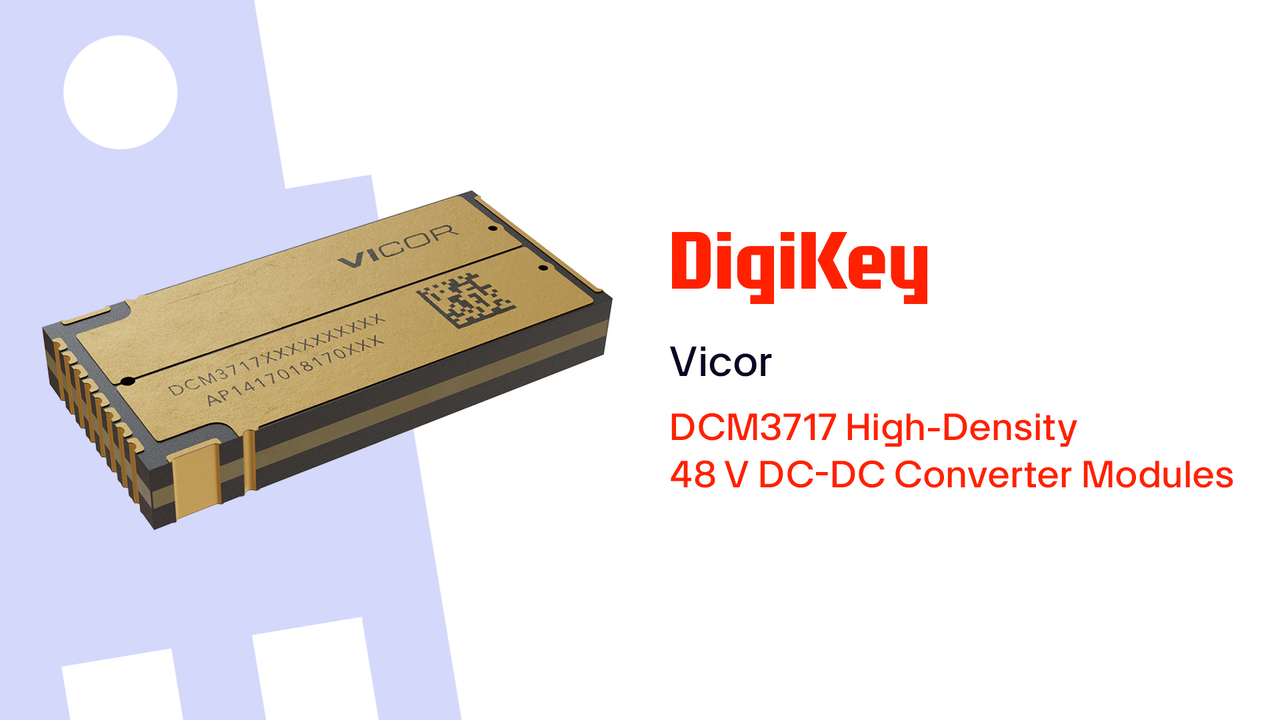
Un convertidor de bus de relación fija establece el bus de 48 V, pero muchas cargas necesitan un voltaje regulado, que es donde entran en juego los convertidores DCM de Vicor. El DCM es un convertidor de CC/CC regulado; el DCM aislado toma una entrada amplia no regulada y produce una salida regulada aislada, mientras que los módulos DCM no aislados de Vicor conectan un bus de 48 V a un riel de voltaje bajo regulado. Los recientes DCM3717 y DCM3735 (figura 1), por ejemplo, funcionan con una entrada de 40 V a 60 V, producen una salida regulada ajustable de alrededor de 10 a 12.5 V (12.2 V nominal) y se pueden poner en paralelo para escalar la potencia del sistema.
 Figura 1: Módulos DCM de alta densidad para puentear buses de potencia de 48 V y buses de 12 V heredados. (Fuente de la imagen: Vicor)
Conclusión
El ecosistema de Vicor abarca conversiones de 800 V, 400 V, 48 V y 12 V, lo que permite a los diseñadores ensamblar una ruta desde una fuente de voltaje alta hasta el punto de carga con módulos compatibles y preservar las inversiones de 12 V mediante la conexión de rieles de 48 V y 12 V.
Para explorar los módulos y las arquitecturas detrás de la conversión de alto voltaje a 48 V, visite la descripción general de Convertir el alto voltaje a 48 V de manera eficiente de Vicor.
Descargo de responsabilidad: Las opiniones, creencias y puntos de vista expresados por los autores o participantes del foro de este sitio web no reflejan necesariamente las opiniones, las creencias y los puntos de vista de DigiKey o de las políticas oficiales de DigiKey.